Posts

Showing posts with the label Star formation

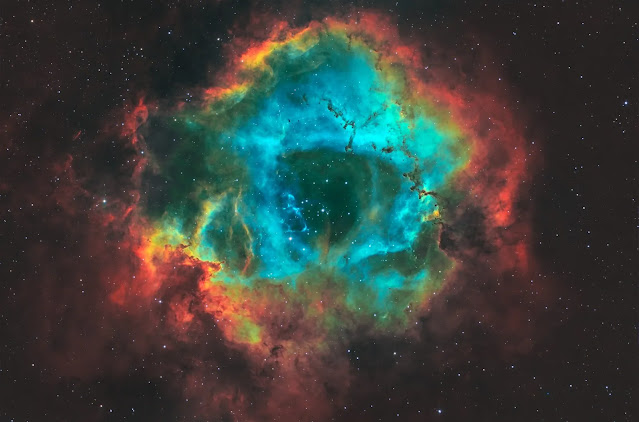
Discovering the Rosette Nebula: A Stellar Nursery in the Cosmos ๐ŸŒน๐ŸŒŒ

Image
 The Rosette Nebula, a stunning and intricate cosmic structure, is a stellar nursery located in the constellation Monoceros, the Unicorn. This beautiful nebula, resembling a rose in full bloom, is a magnificent example of the wonders of the universe. At CuriousWorlds , we invite you to explore the breathtaking Rosette Nebula and uncover the secrets of its formation and significance. What is the Rosette Nebula? The Rosette Nebula (NGC 2237) is a large, circular emission nebula located approximately 5,000 light-years from Earth. Spanning about 130 light-years in diameter, it is part of a larger molecular cloud that also contains the open star cluster NGC 2244. The nebula's striking appearance, with its petal-like structures, is due to the intense radiation and stellar winds from the young, hot stars at its center. Formation and Structure Star Formation: The Rosette Nebula is a stellar nursery, a region where new stars are born. The nebula's central cluster, NGC 2244, contains yo...

The James Webb Space Telescope: Unveiling the Universe's Secrets ๐Ÿ”ญ๐ŸŒŒ

Image
 The James Webb Space Telescope (JWST) represents a monumental leap forward in our quest to understand the cosmos. As the most powerful space telescope ever built, JWST is poised to unlock mysteries about the universe’s formation, evolution, and the potential for life beyond Earth. At CuriousWorlds , we delve into the groundbreaking capabilities of JWST and its potential to revolutionize our understanding of the universe. What is the James Webb Space Telescope? The James Webb Space Telescope is an advanced space observatory developed by NASA, the European Space Agency (ESA), and the Canadian Space Agency (CSA). Launched on December 25, 2021, JWST is designed to succeed the Hubble Space Telescope, providing unprecedented clarity and depth in its observations. Key Features of JWST Infrared Vision: Unlike Hubble, which primarily observes in visible and ultraviolet light, JWST operates mainly in the infrared spectrum. This allows it to see through cosmic dust and observe objects that ...